
All-on-4 vs. All-on-6 Dental Implants: Which System is Better for You?

Losing multiple teeth or struggling with uncomfortable dentures can significantly impact your quality of life, affecting eating, speaking, and confidence. Fortunately, modern dentistry offers advanced solutions like the All-on-4 and All-on-6 systems, providing fixed, full-arch restorations supported by Full Mouth Dental Implants in Turkey. But what’s the difference, and which might be right for you?
This article compares the key aspects of All-on-4 and All-on-6 to help you have an informed discussion with your dental specialist. At HCT Dental Clinic, our multidisciplinary team in Istanbul and Antalya has extensive experience guiding patients through these life-changing procedures.
What are All-on-4 and All-on-6?
Both All-on-4 and All-on-6 are innovative techniques designed to replace a full arch of missing teeth using a fixed bridge anchored to dental implants. They offer a stable, permanent alternative to removable dentures.
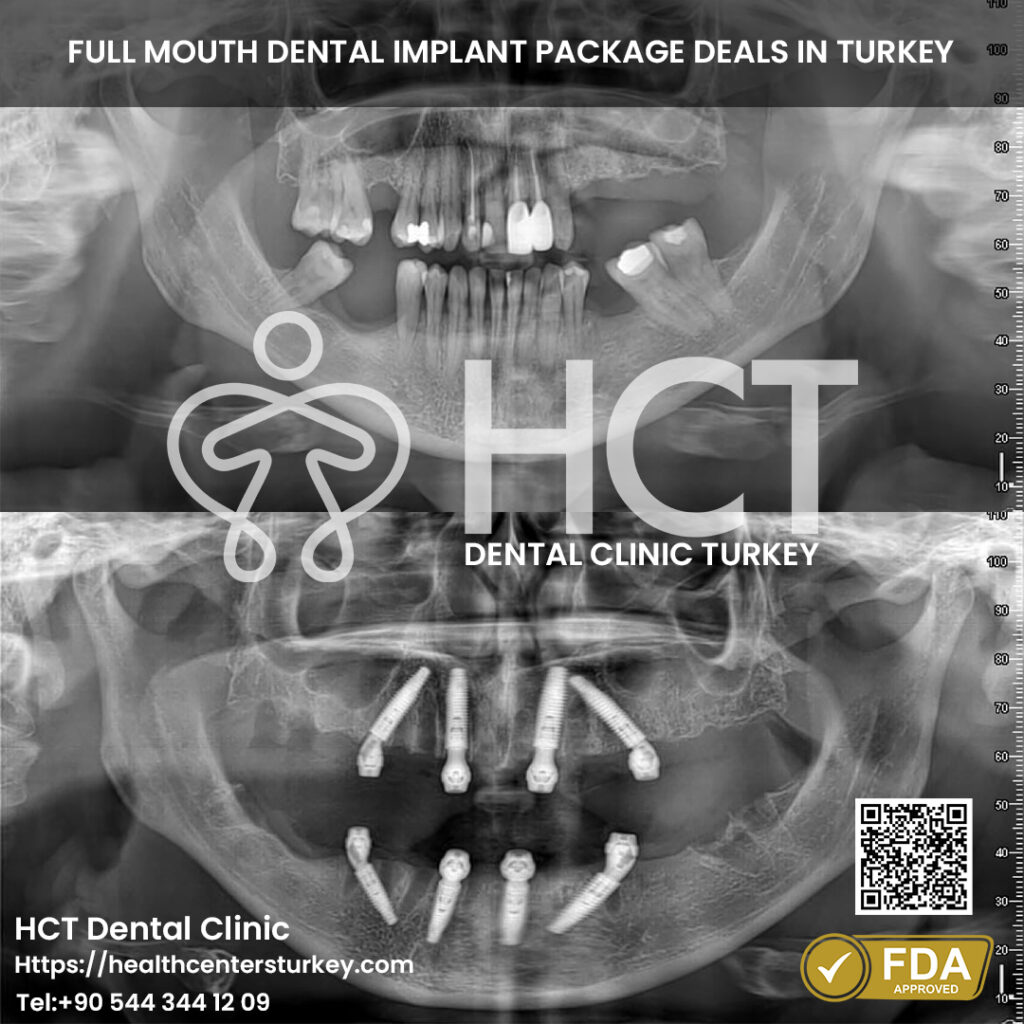
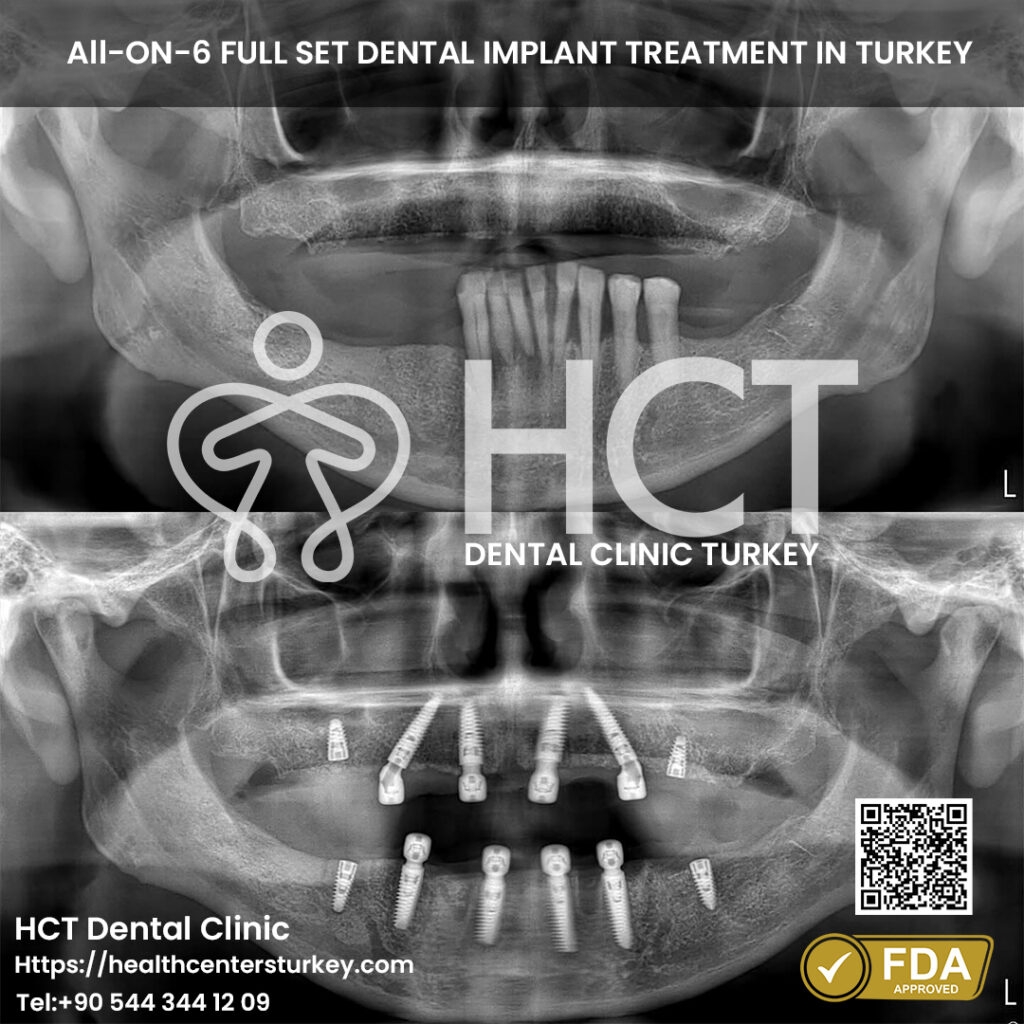
Implants & Placement: The most obvious difference is the number of implants—four versus six. All-on-4’s use of angled posterior implants is a key distinction, designed to engage denser bone often found in the front of the jaw and potentially bypass areas with less bone volume or anatomical structures like sinuses.
Stability & Support: With more anchor points spread across the jaw, All-on-6 generally offers greater intrinsic stability and a more even distribution of biting forces across the prosthesis. This is highly beneficial for long-term durability, especially for patients with a strong bite or those opting for a heavier full Zirconia bridge.
Bone Requirements: All-on-4’s design may allow treatment for patients with moderate bone loss *without* grafting. All-on-6 provides a more robust foundation but is more likely to require sufficient bone volume across a wider area, potentially necessitating procedures like a sinus lift if significant bone loss has occurred.
Complexity & Cost: Adding two more implants generally increases the surgical time and complexity slightly for All-on-6. Consequently, it is associated with a higher cost. However, this increased stability often translates to better long-term value for many individuals.
Key Differences Explained
Implants & Placement: The most obvious difference is the number of implants – four versus six. All-on-4’s use of angled posterior implants is a key distinction, designed to engage denser bone often found in the front of the jaw and potentially bypass areas with less bone volume or anatomical structures like sinuses. All-on-6 typically involves more vertical placements, distributing support more widely across the arch.
Stability & Support: With more anchor points spread across the jaw, All-on-6 generally offers greater intrinsic stability and more even distribution of biting forces across the prosthesis. This inherent stability is beneficial for long-term durability, especially in wider jaw structures where reinforcing the prosthesis framework, often with a titanium or cast bar, further ensures longevity. While All-on-4 has fewer implants, experienced clinics often address this by incorporating a similar reinforcing titanium or cast bar within the prosthesis itself. This technique aims to compensate for the reduced number of implants, enhancing the prosthesis’s lifespan, and our clinical experience shows positive results with this approach.
Bone Requirements: While All-on-4’s design might allow treatment for some patients with moderate bone loss without grafting, All-on-6 often provides a more robust foundation but may be more likely to require sufficient bone volume across a wider area, potentially necessitating bone grafting procedures if significant bone loss has occurred.
Complexity & Cost: Adding more implants generally increases surgical time and complexity slightly for All-on-6. Consequently, it’s often associated with a higher cost compared to All-on-4. However, the increased stability might translate to better long-term value for some individuals.
All On 4 Per Jaw
The All-on-4® treatment concept offers an affordable, graft-free solution, providing patients with a fixed full-arch prosthesis within a week of surgery.-
4 Strauman Neodent or Megagen Implants
-
12 Temporary Fixed Denture
-
Free Transfers from Airport Hotel Clinic
-
Double Room Hotel Stay Bed and Breakfast
-
Mouth Guard
-
Consultation
-
3D Dental tomography & Panoramic X-Ray
-
Local Anesthetics
-
Anti-biotics, Pain killers, mouth wash etc.
-
Laboratory Fees
-
Material Fees
-
The Dentist’s Time & Work
-
The treatment requires two visits, with each visit lasting 6-7 days, spaced over a period of 3 to 6 months.
All On 6 Per Jaw
The All-on-6® treatment concept offers an affordable, graft-free solution, delivering a fixed full-arch prosthesis within a week of surgery.-
6 Strauman Neodent or Megagen Implants
-
12 Temporary Fixed Denture
-
Free Transfers from Airport Hotel Clinic
-
Double Room Hotel Stay Bed and Breakfast
-
Mouth Guard
-
Consultation
-
3D Dental tomography & Panoramic X-Ray
-
Local Anesthetics
-
Anti-biotics, Pain killers, mouth wash etc.
-
Laboratory Fees
-
Material Fees
-
The Dentist’s Time & Work
-
The treatment requires two visits, with each visit lasting 6-7 days, spaced over a period of 3 to 6 months.
EXCELLENTTrustindex verifies that the original source of the review is Google. I had 20 zirconias fitted around 8 weeks ago, they looked after me every step of the way and made me in to a very happy customer. I would certainly recommend them.Posted onTrustindex verifies that the original source of the review is Google. I’m very satisfied with the services provided by Mr. Burak. He was extremely helpful and made sure everything was well-organized from start to finish. The clinic was very professional, and all procedures went smoothly. One of the highlights was that Mr. Burak even dedicated a whole day to show us around Istanbul, which was a lovely experience. He also regularly checked in to ask about my health and well-being, which I really appreciated. The hotel was conveniently located close to the clinic, and all airport transfers—both arrival and departure—were perfectly arranged. I highly recommend his services!Posted onTrustindex verifies that the original source of the review is Google. This is a brilliant clinic, I was looked after by Burak he went above and beyond to help me with everything! I had to travel alone as my friend couldn’t make it! I was looked after the whole way through my teeth are perfect I absolutely love them, it has most definitely give me the confidence to smile again! As soon as I was off the plane I was picked up in a lovely cool car as it was red hot and I was nervous, Burak was there for me outside, I was he took me to my hotel which was perfect and everyday I was picked up, took to the dentist, he even took me to change some money as I didn’t have the correct currency. I could not recommend this company and Burak more! I did loads of research and it paid off don’t look anywhere else your in great hands with this company, everyone loves my teeth and I’m a new woman thanks Burak and the team! Amazing 10 stars 🫶🏼🫶🏼🫶🏼Posted onTrustindex verifies that the original source of the review is Google. My experience with HCT Dental Clinic Antalya was nothing short of amazing! Traveling from the USA to Türkiye (Turkey) was worth every mile traveled. I was received by their amazing staff and delivered to my hotel for check-in. Services began right away. I was picked up for every appointment and brought back to the hotel each day. The dental staff were very friendly and knowledgeable on restoring my dental health and smile. The food was awesome and the views of the city were incredible! The overall experience was top tier and very affordable. I paid a fourth of the cost for my services, compared to the prices here in the States. I highly recommended HCT Antalya! Many Thanks for everything!Posted onTrustindex verifies that the original source of the review is Google. I just wanted to leave a review to talk about my experience with HCT dental clinic, thay have given me the perfect smile , I was well looked after the staff are amazing and friendly I'm so pleased with the final results , I can't thank them enough for giving me the smile I've always dreamed of I highly recommend HCT dental clinic very professional and talked me through step by step as I was a very nervous patient , thay answered all my questions and were helpful in everyday possible, I honestly can't thank them enough definitely a 5 star plus rating .Posted onTrustindex verifies that the original source of the review is Google. Impilant tedavimi bu klinikte yaptirdim doktorlar ve bilgilendirme cok iyiydi. Tedavimden cok memnun kaldim. Herkese tavsiye ederim.Posted onTrustindex verifies that the original source of the review is Google. Dis tedavimi bu klinikte yapmaya karar verdim. Ilgi ve doctor tecrubesi Marika her adimi acikladilar ve taking etmem gereken kurallari anlattilar. Tekrardan yemek yiyebildigim icin mutluyum. Herkese tavsiye ederimPosted onTrustindex verifies that the original source of the review is Google. Almanya köln den geldim hollywood smile tedavisi gördüm çok memnunum çok beğendim harika bir yer tavsiye ederimPosted onTrustindex verifies that the original source of the review is Google. Just want to leave my review as it’s important for people to find the best treatment in turkey so it’s a 5 star plus from me. So here’s my story I’ve been here 3 years ago by myself for teeth treatment with HCT and it’s best thing I’ve ever done with teeth still looking good and going strong excellent service with mr Burak and staff helped a lot with arrival and made me feel welcome, so about a month ago I contacted HCT about getting hair transplant and they found me an excellent hotel called Laren family hotel with staff great clean and good food, so it’s early stages with hair treatment dun two weeks ago but everything ok so far as I had an really good clinic with staff who you can really tell they love and care about the work they do so yes 5 stars from me and I’ve recommended a few friends back home so thanks to Mr Burak and team much appreciated 👍👍👍Posted onTrustindex verifies that the original source of the review is Google. Klinika na wysokim poziomie, nowoczesna a personel z ogromną wiedzą i doświadczeniem dla którym liczy się przede wszystkim dobro i zdrowie pacjenta . Polecam z całego serca ♥️Verified by TrustindexTrustindex verified badge is the Universal Symbol of Trust. Only the greatest companies can get the verified badge who has a review score above 4.5, based on customer reviews over the past 12 months. Read more
Pros and Cons: A Quick Comparison
All-on-4
- Pros: Potentially less invasive surgery, may avoid bone grafting, often more cost-effective initially.
- Cons: Relies heavily on fewer implants, potentially less overall stability compared to All-on-6 (unless reinforced).
All-on-6
- Pros: Excellent stability and force distribution, provides redundancy (if one implant has an issue, the bridge is often still stable), ideal for full zirconia bridges.
- Cons: Higher cost, may require more available bone or grafting, slightly longer/more complex surgery.
Is 6 Implants Always Better Than 4?
(Attributed to: Prof. Dr. MÜJDE SEVİMAY – Head Dentist & Prosthodontics Professor)
“Patients always ask, ‘Why wouldn’t I just get 6 implants? Isn’t it always stronger?’ As a prosthodontist, my answer is that the choice is about prosthetic engineering, not just numbers. The All-on-4 system is a brilliant surgical solution to avoid vital structures (like nerves or the sinus) and prevent the need for bone grafts. It’s purpose-built for specific anatomies.
However, from a purely prosthetic standpoint, the 6 implants in an All-on-6 give my team a wider, more distributed foundation. This “A-P spread” (Anterior-Posterior spread) allows us to distribute biting forces far more evenly, which is critical for patients with a strong bite or for supporting a heavier, full-zirconia bridge. The decision is a team one: Dr. Ataseven (our surgeon) confirms what the bone allows, and I (as the prosthodontist) confirm what the final prosthesis requires.”
Making the Right Choice for You
There is no single “better” system; the optimal choice is highly personalized. At HCT Dental Clinic, this is never a guess. It is a decision made by our multidisciplinary team, based on your 3D CBCT scan.
The process involves two key experts:
- The Surgeon (Dr. Aslı Ataseven): Our Maxillofacial Surgeon first analyzes your 3D scan to determine your bone volume. She answers the question: “Surgically, can we place 6 implants safely, or does your anatomy (low sinuses, nerve location) make the angled 4-implant system a safer, graft-free solution?”
- The Prosthodontist (Prof. Dr. Müjde Sevimay): Prof. Dr. Sevimay then answers the prosthetic question: “What does the bridge need?” Based on your jaw size and biting force, she determines if 4 implants are sufficient for long-term stability or if the 6-implant foundation is required for your case.
Only when both specialists agree do we finalize your treatment plan.
Not necessarily. “Better” depends on your specific anatomy. All-on-6 provides a wider base of support, which is ideal for large jaws or full zirconia bridges. However, All-on-4 is a superior solution for patients with moderate bone loss in the back of the jaw, as its angled implants can often prevent the need for a separate sinus lift surgery.
No. The surgery itself is performed under deep sedation or local anesthesia. You will not feel pain during the procedure. Post-operative soreness and swelling are normal for the first few days, but this is well-managed with the prescribed pain medication and anti-inflammatories.
The angled (tilted) posterior implants are the key innovation. They are designed to engage the denser bone found in the front of the jaw, bypassing the weak bone in the back (where the sinuses are in the upper jaw, or the nerve is in the lower jaw). This technique is what allows many patients to get fixed teeth without bone grafting.
Conclusion & Next Steps
Both All-on-4 and All-on-6 offer remarkable, fixed solutions for Full Mouth Reconstruction Turkey. Understanding their core differences helps, but the final decision hinges on an expert evaluation of your individual case.
Ready to explore the best path to restoring your smile? Our expert patient coordinators in Istanbul and Antalya are ready to arrange your free, no-obligation 3D scan and consultation with our specialist team.
Legal Disclaimer
The information provided in this article is for informational purposes only and does not constitute medical advice. The content is not intended to be a substitute for professional medical diagnosis or treatment. Always seek the advice of your dentist or another qualified health provider with any questions you may have regarding a medical condition.
Prof. Dr. Müjde Sevimay
Prosthodontics Specialist | Faculty Member at Antalya Bilim UniversityProf. Dr. Müjde Sevimay is a distinguished specialist in Prosthetic Dentistry with over 25 years of extensive academic and clinical experience. After completing her PhD in 2002, she has built a significant academic career, achieving the rank of Professor in 2015. She has authored numerous articles in prestigious international journals, and her research focuses on implant-supported prostheses, aesthetic restorations, and contemporary dental materials.
- Education: PhD in Prosthodontics, Selçuk University (2002)
- Experience: 25+ Years (Since 1998)
- Authority: Widely published in national & international scientific journals.
- Research Focus: Implantology, Aesthetic Dentistry, Dental Materials.
- View Google Scholar Profile
This document is reviewed and approved Oral and Maxillofacial Surgeon Aslı Atasaven and Gülsün Inal Yıldırım and HCT Dental Clinic CEO