
Is Composite Bonding in Turkey Safe? A Specialist's Guide to Materials, Clinic Accreditation & Risks (2026)

Composite bonding in Turkey has become a remarkably popular choice for international patients, offering a fast, minimally invasive, and affordable path to a perfect smile. However, this popularity, often highlighted by the “Turkey Teeth” trend on social media, has also created a wave of uncertainty. You may have seen the attractive prices—perhaps even on our Composite Bonding in Turkey Cost page—and then asked yourself the most important question: “Is it truly safe?”
It’s a valid and critical question. As internationally-minded experts at HCT Dental Clinic, with locations serving patients in both Istanbul and Antalya, your safety and confidence are our primary concerns.
The answer is yes, composite bonding in Turkey is exceptionally safe, provided you choose the right clinic. The safety of your treatment doesn’t depend on the country; it depends on the clinic’s accreditation, the quality of materials used, and the skill of the specialist performing the procedure.
The Core Question: Why is Composite Bonding Cheaper in Turkey?
Let’s address the main source of suspicion first: the price. When patients from the UK, Europe, or the USA see the affordable cost, they often assume it must be due to lower quality.
This is incorrect. The affordability of dental Dental Treatments in Turkey is not due to compromises in quality but to economic factors:
- Lower Operational Costs: The cost of running a high-tech clinic, including rent and utilities, is significantly lower in Turkey.
- Favorable Exchange Rates: The currency exchange rate provides a major financial advantage for international patients.
- Government Support: The Turkish government actively supports the health tourism sector, allowing clinics to offer competitive pricing.

Winner: Best Health Tourism Co. 2023

AACI International Accredited
Int'l Health Tourism Certificate
Turkish Dental Association
ISO 9001:2015 Quality Certified
Winner: Best Health Tourism Co. 2023
AACI International Accredited
Int'l Health Tourism Certificate
Turkish Dental Association
ISO 9001:2015 Quality Certified
EXCELLENTTrustindex verifies that the original source of the review is Google. I had 20 zirconias fitted around 8 weeks ago, they looked after me every step of the way and made me in to a very happy customer. I would certainly recommend them.Posted onTrustindex verifies that the original source of the review is Google. I’m very satisfied with the services provided by Mr. Burak. He was extremely helpful and made sure everything was well-organized from start to finish. The clinic was very professional, and all procedures went smoothly. One of the highlights was that Mr. Burak even dedicated a whole day to show us around Istanbul, which was a lovely experience. He also regularly checked in to ask about my health and well-being, which I really appreciated. The hotel was conveniently located close to the clinic, and all airport transfers—both arrival and departure—were perfectly arranged. I highly recommend his services!Posted onTrustindex verifies that the original source of the review is Google. This is a brilliant clinic, I was looked after by Burak he went above and beyond to help me with everything! I had to travel alone as my friend couldn’t make it! I was looked after the whole way through my teeth are perfect I absolutely love them, it has most definitely give me the confidence to smile again! As soon as I was off the plane I was picked up in a lovely cool car as it was red hot and I was nervous, Burak was there for me outside, I was he took me to my hotel which was perfect and everyday I was picked up, took to the dentist, he even took me to change some money as I didn’t have the correct currency. I could not recommend this company and Burak more! I did loads of research and it paid off don’t look anywhere else your in great hands with this company, everyone loves my teeth and I’m a new woman thanks Burak and the team! Amazing 10 stars 🫶🏼🫶🏼🫶🏼Posted onTrustindex verifies that the original source of the review is Google. My experience with HCT Dental Clinic Antalya was nothing short of amazing! Traveling from the USA to Türkiye (Turkey) was worth every mile traveled. I was received by their amazing staff and delivered to my hotel for check-in. Services began right away. I was picked up for every appointment and brought back to the hotel each day. The dental staff were very friendly and knowledgeable on restoring my dental health and smile. The food was awesome and the views of the city were incredible! The overall experience was top tier and very affordable. I paid a fourth of the cost for my services, compared to the prices here in the States. I highly recommended HCT Antalya! Many Thanks for everything!Posted onTrustindex verifies that the original source of the review is Google. I just wanted to leave a review to talk about my experience with HCT dental clinic, thay have given me the perfect smile , I was well looked after the staff are amazing and friendly I'm so pleased with the final results , I can't thank them enough for giving me the smile I've always dreamed of I highly recommend HCT dental clinic very professional and talked me through step by step as I was a very nervous patient , thay answered all my questions and were helpful in everyday possible, I honestly can't thank them enough definitely a 5 star plus rating .Posted onTrustindex verifies that the original source of the review is Google. Impilant tedavimi bu klinikte yaptirdim doktorlar ve bilgilendirme cok iyiydi. Tedavimden cok memnun kaldim. Herkese tavsiye ederim.Posted onTrustindex verifies that the original source of the review is Google. Dis tedavimi bu klinikte yapmaya karar verdim. Ilgi ve doctor tecrubesi Marika her adimi acikladilar ve taking etmem gereken kurallari anlattilar. Tekrardan yemek yiyebildigim icin mutluyum. Herkese tavsiye ederimPosted onTrustindex verifies that the original source of the review is Google. Almanya köln den geldim hollywood smile tedavisi gördüm çok memnunum çok beğendim harika bir yer tavsiye ederimPosted onTrustindex verifies that the original source of the review is Google. Just want to leave my review as it’s important for people to find the best treatment in turkey so it’s a 5 star plus from me. So here’s my story I’ve been here 3 years ago by myself for teeth treatment with HCT and it’s best thing I’ve ever done with teeth still looking good and going strong excellent service with mr Burak and staff helped a lot with arrival and made me feel welcome, so about a month ago I contacted HCT about getting hair transplant and they found me an excellent hotel called Laren family hotel with staff great clean and good food, so it’s early stages with hair treatment dun two weeks ago but everything ok so far as I had an really good clinic with staff who you can really tell they love and care about the work they do so yes 5 stars from me and I’ve recommended a few friends back home so thanks to Mr Burak and team much appreciated 👍👍👍Posted onTrustindex verifies that the original source of the review is Google. Klinika na wysokim poziomie, nowoczesna a personel z ogromną wiedzą i doświadczeniem dla którym liczy się przede wszystkim dobro i zdrowie pacjenta . Polecam z całego serca ♥️Verified by TrustindexTrustindex verified badge is the Universal Symbol of Trust. Only the greatest companies can get the verified badge who has a review score above 4.5, based on customer reviews over the past 12 months. Read more
Understanding the "Real" Risks of Composite Bonding (Anywhere)
To understand safety, we must first be transparent about the universal risks of composite bonding, whether you have it done in London, New York, or Istanbul:
- Staining: Composite resin is more porous than porcelain. Over time, it can absorb stains from coffee, tea, red wine, or smoking.
- Chipping or Fracturing: While durable, composite material is not as strong as porcelain veneers or natural teeth. Biting down on very hard objects (like ice or pens) can cause chips.
- Longevity: Composite bonding typically lasts 5-7 years, whereas porcelain veneers can last 15 years or more.
The crucial point is this: These risks are dramatically increased by two factors: low-quality (cheap) materials and poor application technique.
This is where the difference between a safe, accredited clinic and a risk-filled “dental shop” becomes clear.


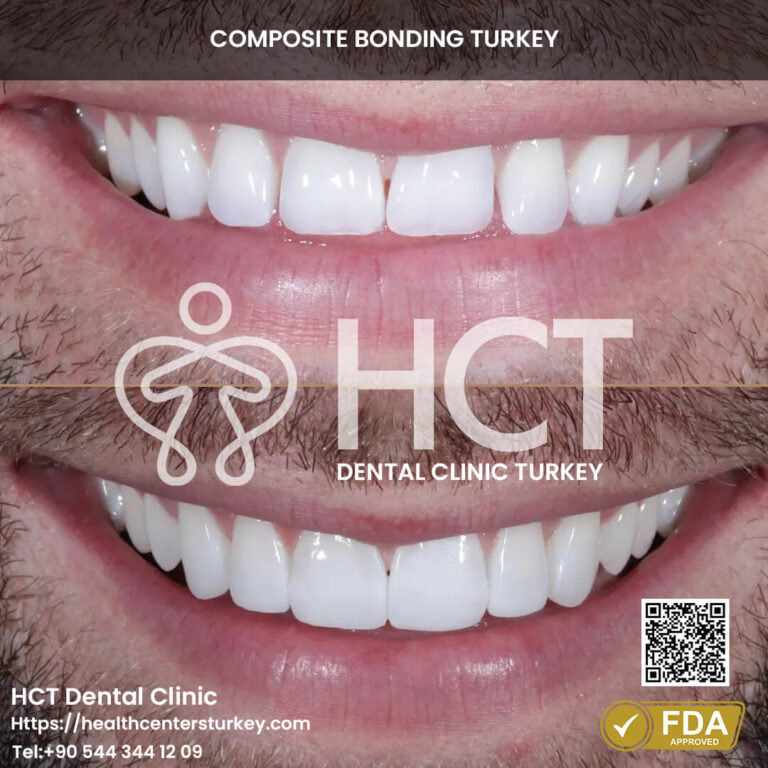
How HCT Dental Clinic Mitigates Every Risk: Our Safety
At our Istanbul and Antalya clinics, we don’t just meet safety standards; we aim to exceed them. Here is how we address every potential risk.
The Material Risk: We Use Only MDR-Certified Premium Brands
The “composite” in “composite bonding” is a resin material. The market is flooded with cheap, low-grade resins that stain easily and fracture quickly.
Our Clinical Solution:
We exclusively use industry-leading, nano-hybrid composite brands that are MDR (Medical Device Regulation) certified, ensuring they meet the highest European standards.
- Our primary choices are 3M Filtek Supreme, Ivoclar Vivadent (Tetric EvoCeram), and other nano-filltek composites.
Aesthetic Smile Doctor, Dr. Betül Semercioğlu, explains: “The choice of material is critical. Nano-hybrid composites, like 3M Filtek, contain tiny particles that allow us to not only sculpt the tooth perfectly but also polish it to a high, stain-resistant gloss. Cheaper materials look dull and will pick up coffee stains within months. We simply refuse to use them.”
The Expertise Risk: Your Treatment is Done by a Specialist
In some clinics, bonding is performed by a general dentist. Bonding is an art form. It requires a deep understanding of dental morphology, color matching, and light refraction to look natural.
Our Clinical Solution:
Your procedure is performed by an Aesthetic Smile Doctor, not a general practitioner.
Head Dentist & Prosthodontics Professor, Prof. Dr. MÜJDE SEVİMAY, notes: “A successful bonding isn’t just about covering a chip. It’s about recreating a natural tooth that is in perfect harmony with the patient’s bite (occlusion). A poorly shaped bond can interfere with the bite, leading to jaw pain or chipping. This requires a specialist’s eye.”
The Clinic & Aftercare Risk: Accreditation is Your Guarantee
How do you know if a clinic is truly safe? You look for external, objective proof.
Our Clinical Solution:
HCT Dental Clinic is fully accredited by the Turkish Dental Association (TDB) and operates under strict protocols governed by our International Health Tourism Certificate and ISO 9001 certification.
- What this means for you: These certifications are a legal guarantee that our clinic adheres to the highest international standards for sterilization, patient care, and quality management.
- A common concern we hear from our UK patients is, “What happens if a bond chips when I’m back home?” Because we use premium materials and specialist application, the risk is minimal. However, our international patient coordinators are always available for support, and we provide a comprehensive aftercare guide to protect your investment.
A Specialist's View on Bonding Safety & Success
Prof. Dr. MÜJDE SEVİMAY
(Head Dentist & Prosthodontics Professor)
“In my experience, the safety and success of composite bonding depend on two factors often overlooked. First, the ‘enamel etching protocol.’ A poorly prepared tooth surface is the number one reason for premature bond failure (debonding). We use a precise, multi-stage etching and bonding agent protocol to create a micro-mechanical lock between the resin and your tooth.
Second, patients worry about their natural teeth being “ruined.” This is a major confusion with aggressive crowns. Composite bonding is the opposite. It is an additive procedure; we are adding to your tooth, not drilling it down. It is the safest, most conservative way to restore a smile. The only risk to your tooth is if an unqualified person applies the bond incorrectly, which is why choosing a specialist-led clinic is non-negotiable.”
Accreditation: The Non-Negotiable Sign of a Safe Clinic
When researching clinics in Turkey, your first check should be for accreditation.
- TDB (Turkish Dental Association): Ensures the dentists are fully licensed and adhere to ethical codes.
- ISO 9001:2015: A global standard for quality management systems. It proves the clinic has consistent, repeatable, high-quality processes for everything from patient registration to sterilization.
- International Health Tourism Certificate: Issued by the Turkish Ministry of Health, this is a legal requirement for clinics treating international patients, proving they meet rigorous standards for facilities, staff, and emergency preparedness.
A clinic operating without these is a serious red flag.
Is Composite Bonding Always the Right Choice?
Part of being a “safe” clinic means being an “honest” one. At HCT Dental Clinic, we will recommend the best treatment for you, not just the one you asked for.
Composite bonding is fantastic, but it’s not the right solution for every problem.
- Contraindication 1: Severe Misalignment. If your teeth are significantly crooked, bonding will only provide a cosmetic mask. The real, long-term solution would be orthodontic treatment, such as Invisalign.
- Contraindication 2: Heavy Bruxism (Grinding). If you are a heavy grinder, you will likely fracture composite bonds quickly. In this case, a more durable Zirconia Crown or E-max Veneer would be a safer and more durable investment.
According to the American Academy of Cosmetic Dentistry (AACD), a successful procedure starts with the right diagnosis and treatment planning, which is a core part of our “safety” protocol.
Your Safe Composite Bonding Journey in Istanbul & Antalya
A safe journey is a predictable one. Here’s what to expect:
- Initial (Remote) Consultation: You’ll send photos to our team in Istanbul or Antalya. Our specialists (like Dr. Betül Semercioğlu) will create a personalized treatment plan.
- The Visit: A common question we hear is, “Will I really be finished in one trip?” Yes. Composite bonding is a “single-visit” smile makeover.
- The Procedure: The doctor artistically sculpts the premium composite resin directly onto your teeth, layer by layer, and cures it with a special light. There is typically no drilling and no anesthesia required.
- The Final Polish: The new restorations are meticulously polished to a natural, high-gloss finish. You leave the clinic with an instantly transformed smile.
Conclusion: Safety is a Choice, Not a Gamble
So, is composite bonding in Turkey safe?
Yes—when you make safety your priority. If you choose a clinic based on “rock-bottom” prices without checking its credentials, you are taking a risk.
But if you choose an accredited clinic like HCT Dental Clinic, you are not compromising. You are simply making a “smart value” investment. You receive care from specialist doctors, are treated with the world’s best 3M and Ivoclar materials, and are protected by ISO and TDB certifications, all while benefiting from Turkey’s economic advantages.
Don’t gamble with your smile. Choose guaranteed safety and proven expertise.
Frequently Asked Questions
Does composite bonding in Turkey ruin your real teeth?
Why do some UK dentists warn against "Turkey Teeth"?
Do I get a guarantee for composite bonding in Turkey?
What's the difference between cheap and premium composite materials?
Prof. Dr. Müjde Sevimay
Prosthodontics Specialist | Faculty Member at Antalya Bilim UniversityProf. Dr. Müjde Sevimay is a distinguished specialist in Prosthetic Dentistry with over 25 years of extensive academic and clinical experience. After completing her PhD in 2002, she has built a significant academic career, achieving the rank of Professor in 2015. She has authored numerous articles in prestigious international journals, and her research focuses on implant-supported prostheses, aesthetic restorations, and contemporary dental materials.
- Education: PhD in Prosthodontics, Selçuk University (2002)
- Experience: 25+ Years (Since 1998)
- Authority: Widely published in national & international scientific journals.
- Research Focus: Implantology, Aesthetic Dentistry, Dental Materials.
- View Google Scholar Profile
Conclusion & Next Steps
Both All-on-4 and All-on-6 offer remarkable, fixed solutions for Full Mouth Dental Implants in Turkey. Understanding their core differences helps, but the final decision hinges on expert evaluation of your individual case.
Ready to explore the best path to restoring your smile? Contact Health Centers Turkey today to schedule your personalized consultation.
Legal Disclaimer
The information provided in this article is for informational purposes only and does not constitute medical advice. The content is not intended to be a substitute for professional medical diagnosis or treatment. Always seek the advice of your dentist or another qualified health provider with any questions you may have regarding a medical condition.