
The Ultimate Guide to Dental Veneers in Turkey: Procedure, Types & 2026 Costs
Are you hiding your smile in photos because of chips, gaps, or discoloration? You are not alone. For many of our international patients visiting HCT Dental Clinic, the dream of a flawless smile often feels out of reach due to the prohibitive costs of cosmetic dentistry in the UK, USA, or Europe.
This is where the concept of a “Dental Holiday” transforms from a simple trip into a smart investment. Dental veneers offer a life-changing solution, correcting aesthetic imperfections with minimal interference. However, we know that navigating the world of “Turkey Teeth” on social media can be confusing.
In this comprehensive 2026 guide, we will move beyond the myths. We will explain exactly how our clinics in Istanbul and Antalya utilize world-class materials like Ivoclar E-max to design smiles that are not just white, but naturally translucent and medically sound.


What Are Dental Veneers?
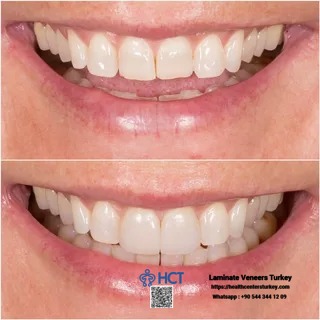
Think of dental veneers as the “contact lenses” for your teeth. They are ultra-thin, custom-made shells crafted to cover the front surface of your teeth. Unlike dental crowns, which require covering the entire tooth structure, veneers are a minimally invasive solution designed to preserve your natural tooth structure as much as possible.
At HCT Dental Clinic, we use veneers to effectively correct:
- Severe Discoloration: Stains from tetracycline or fluorosis that do not respond to Teeth Whitening.
- Physical Damage: Chipped, broken, or worn-down teeth.
- Spacing Issues: Gaps (diastema) between teeth that you want to close without braces.
- Minor Misalignment: Giving the appearance of a straight smile instantly.
Note on Suitability: Veneers are purely cosmetic. If your teeth have severe structural damage or decay, they may not be the right solution. In such cases, we might recommend Dental Crowns or, if tooth loss is present, Dental Implants.
Read more: how long Turkey teeth veneers last.
Read more: full set dental veneers cost for 20 teeth.
Read more: veneers in Turkey vs UK quality of care.
Read more: laser bleaching guide before getting dental veneers.
Read more: zirconium vs E-Max veneers — which material to choose.
Read more: lumineers vs laminate veneers comparison guide.
Types of Veneers: Choosing the Right Material
Not all veneers are created equal. Depending on your needs, budget, and the condition of your teeth, your dentist may recommend one of several types. Here’s a breakdown of the most common options.
Porcelain Veneers (E-max & Laminate)
These are the gold standard in cosmetic dentistry. We predominantly use Ivoclar E-max (Lithium Disilicate) or Vita ceramics.
- Appearance: They mimic the light-reflecting properties of natural teeth perfectly.
- Durability: Highly resistant to coffee, tea, and cigarette stains. They typically last 10–15 years.
- Procedure: Requires 2 visits over 5-7 days.
- Learn More: E-max Full Porcelain Crown vs Veneers
- Pricing: See our Laminate Veneers Cost Turkey 2026 guide.
Composite Veneers (Direct Bonding)
Also known as “Composite Bonding,” this is a quicker, more affordable alternative using high-grade resin (often 3M Filtek or Tokuyama).
- Appearance: Excellent, though slightly less translucent than porcelain.
- Durability: 5–7 years; more prone to staining over time.
- Procedure: Can often be completed in a single visit (“Same Day Smiles”).
- Is it safe? Read our guide: Is Composite Bonding in Turkey Safe?
Zirconia Veneers
While Zirconia is often used for crowns due to its immense strength, it can also be used for veneers in patients with severe bruxism (grinding). We utilize Zirkonzahn or Straumann grade zirconia blocks.
- Comparison: Zirconium vs. E-max Veneers
The "Turkey Teeth" Myth vs. Reality: Addressing Your Fears
We know the term “Turkey Teeth” is trending on TikTok, often showing teeth filed down to tiny pegs. This is not how veneers are done at a reputable medical facility.
- The Myth: “They will shave 70% of my tooth away.”
- The Reality at HCT: Veneers require minimal preparation—usually only shaving 0.3mm to 0.5mm of enamel (about the thickness of a fingernail). The aggressive filing seen online is typically for dental crowns, not veneers. We prioritize preserving your natural tooth biology.
Patient’s Voice: A common concern we hear in our Istanbul clinic is, “Will it hurt, and will my teeth be sensitive forever?” We address this by using local anesthesia during preparation. Most patients report only mild sensitivity for a few days, which subsides quickly. You are never left in pain. For a deeper look, read our guide on the safety of dental tourism in Turkey.
💡 Expert Insight: The Importance of the "Golden Ratio"
"A perfect smile isn't just about white teeth; it's about harmony."
Many patients come to us asking for the "whitest possible shade" (often called BL1). However, as a prosthodontist, I always advise looking at the bigger picture. We use digital smile design to apply the Golden Ratio to your face. The size of your veneers must match your lip line, gum contours, and facial symmetry. If we ignore your bite function (occlusion) just for aesthetics, the veneers will chip. True cosmetic dentistry is 50% art and 50% engineering.
— Prof. Dr. MÜJDE SEVİMAY, Head Dentist & Prosthodontics Professor


The 5-Day Patient Journey in Turkey
Many of our patients from the UK and USA ask, “Can I really finish this in less than a week?” Yes. Here is how your itinerary looks in Istanbul or Antalya:
Day 1: Consultation & Smile Design
Upon arrival, you will meet with our aesthetic specialists, Dr. Betül Semercioğlu or Dr. Wahid Kathuda.
- We take 3D CT Scans and digital impressions.
- We select the color and shape of your new smile together.
- Treatment: Minimal preparation of teeth is done, and temporary veneers are placed so you never look “gap-toothed.”
Day 2-3: The “Holiday” Phase
While our laboratory technicians meticulously craft your veneers using CAD/CAM technology, you are free to explore the historic streets of Istanbul or the beaches of Antalya.
Day 4: Trial Fitting
You return to the clinic to “try on” the veneers. We check the fit, bite, and aesthetics. If you want adjustments (e.g., “make them slightly rounder”), we do it here.
Day 5: Final Bonding
Once you are 100% happy, Prof. Dr. Müjde Sevimay or our specialists will permanently bond the veneers using high-strength resin cement. A final polish ensures they shine naturally.
2026 Cost Analysis: Turkey vs. UK/USA
Why is Turkey so much more affordable? It is not about lower quality; it is about lower operational costs (labor, lab fees, facility expenses). Below is a comparison for a standard E-max Porcelain Veneer.
For a full breakdown of packages, please read our Smile Makeover Turkey Cost 2025 Guide.
| Treatment Type | Avg. Cost in UK/USA | Avg. Cost in Turkey (HCT) | Potential Savings |
|---|---|---|---|
| Porcelain Veneer (Per Tooth) | £800 - £1,200 | £150 - £250 | ~80% |
| Composite Bonding (Per Tooth) | £300 - £500 | £100 - £150 | ~60% |
| Full Smile Makeover (20 Teeth) | £16,000 - £24,000 | £3,000 - £5,000 | ~80% |
| Consultation & X-Rays | £100 - £200 | FREE | 100% |
Who is NOT a Candidate? (Contraindications)
We believe in honest medicine. Veneers might not be right for you if:
- You have active Gum Disease: Unhealthy gums will cause veneers to fail. You must undergo Gum Disease Treatment first.
- You grind your teeth severely (Bruxism): Heavy grinding can fracture porcelain. In this case, we might recommend Zirconia crowns or require you to wear a Night Guard post-treatment.
- Severe Misalignment: If your teeth are very crooked, veneers cannot fix the root cause. We may suggest Orthodontic Treatment (like Invisalign) before veneers.
Aftercare: How to Maintain Your New Smile
Your veneers can last over 15 years if treated with respect.
- Hygiene: Brush twice daily with non-abrasive toothpaste. Floss daily.
- Diet: Avoid biting directly into very hard foods (like ice, uncracked nuts, or opening bottles with teeth).
- Regular Checks: Visit your local dentist every 6 months for cleaning.
Are you ready to transform your life? Whether you choose the cultural hub of Istanbul or the resort paradise of Antalya as part of your dental holiday in Turkey, HCT Dental Clinic is ready to guide you.


FAQ
How long do veneers last?
Is the veneer procedure painful?
Can veneers stain like natural teeth?
Do you shave my teeth down to "pegs" for veneers?
Can I get veneers if I have gum disease?
Legal Disclaimer
The information provided in this article is for informational purposes only and does not constitute medical advice. The content is not intended to be a substitute for professional medical diagnosis or treatment. Always seek the advice of your dentist or another qualified health provider with any questions you may have regarding a medical condition.

Prof. Dr. Müjde Sevimay
Prosthodontics Specialist | Faculty Member at Antalya Bilim UniversityProf. Dr. Müjde Sevimay is a distinguished specialist in Prosthetic Dentistry with over 25 years of extensive academic and clinical experience. After completing her PhD in 2002, she has built a significant academic career, achieving the rank of Professor in 2015. She has authored numerous articles in prestigious international journals, and her research focuses on implant-supported prostheses, aesthetic restorations, and contemporary dental materials.
- Education: PhD in Prosthodontics, Selçuk University (2002)
- Experience: 25+ Years (Since 1998)
- Authority: Widely published in national & international scientific journals.
- Research Focus: Implantology, Aesthetic Dentistry, Dental Materials.
- View Google Scholar Profile